

Every few weeks somebody sends us a picture of a wall. It’s from a trip, or a designer’s folder, or Zillow. Sometimes it’s a farmhouse outside Siena, sometimes a chateau in the Dordogne, and a fair amount of the time it’s a house in Montecito that went up in 2011. The question is always the same one. Can you get this.
Usually we can. But the photo is never only a photo of stone. It’s stone, plus a mortar joint, plus whatever the mason decided to do that week, plus two thousand years of accumulated habit behind all three. People order the stone and are surprised when they’ve bought a third of the picture.
Here’s the rest of it, along with what natural stone veneer actually costs and what it takes to get an exterior looking right. If you already have the photo in hand, send it over or call us. Identifying and matching stone is most of what we do.
Rome built it first, and built it better than anyone managed for the next thousand years
The scale is hard to believe even standing in front of it. The Colosseum took something on the order of 100,000 cubic meters of travertine, quarried at Tivoli twenty miles east and hauled to the site block by block. The stones were cut so precisely they were stacked without mortar and pinned with iron clamps, roughly 300 tons of iron holding the building together. Every pockmark across that facade today is a hole somebody chiseled in the Middle Ages to pry the iron back out. The stonework survived the empire, the looting, and eleven centuries of earthquakes, and it’s still standing.
Two Roman habits in particular are why your architect’s elevation looks the way it does.
The first is opus quadratum, building with large squared blocks laid in courses. Every dressed limestone surround, sill, header and quoin on a European-style house descends from it. Rome worked out that a smooth cut jamb set against a rough field wall is worth more than either surface alone, and nobody has improved on the idea since.
The second is rustication: leaving the face of a block rough and boldly textured while cutting its margins clean and square. Go look at the Porta Maggiore, a gate Claudius finished in 52 AD that doubles as a piece of aqueduct, with the channels of the Aqua Claudia and the Anio Novus running across the top of it. The travertine looks like the masons walked off the job. They didn’t. A rough face throws shadow and reads as heavy, permanent, old. A polished one reads as new, and it always will.
Rome also invented the building everybody is chasing. The villa rustica was a working country estate, house and courtyards and garden walls and outbuildings, cut into a hillside and built from whatever the ground nearby gave up. Around the Mediterranean that meant limestone, since the whole basin is limestone. Cream, buff, gold, honey, silvery gray. The palette the world now reads as Italian is the local geology.
Then a thousand years of people trying to do it again
The empire came apart. The buildings stayed up, and every few centuries somebody had another run at matching them.
The Romanesque period, roughly the 10th through 12th centuries, was the first serious attempt, and the name is literal. In the manner of the Romans. Masons across Italy, France and Spain brought back the round arch and the thick load-bearing limestone wall, cut every stone by hand, and bedded it in lime mortar.
The Renaissance version was closer to archaeology. Brunelleschi and Donatello went down to Rome in the early 1400s and dug around the ruins with their own hands, measuring capitals and vaults, and Romans watching them assumed they were treasure hunters. What Brunelleschi brought back rebuilt Florence. The palazzi from that stretch wear it openly. Stand in front of the Medici Riccardi or the Strozzi and you’re looking at rusticated blocks laid heaviest at the street, rough and pillowed in the center with the margins cut clean, refining as the building rises. Palladio did the same fieldwork a century later, published The Four Books of Architecture in 1570, and built the villas of the Veneto that went on to shape country houses across Europe and then America.
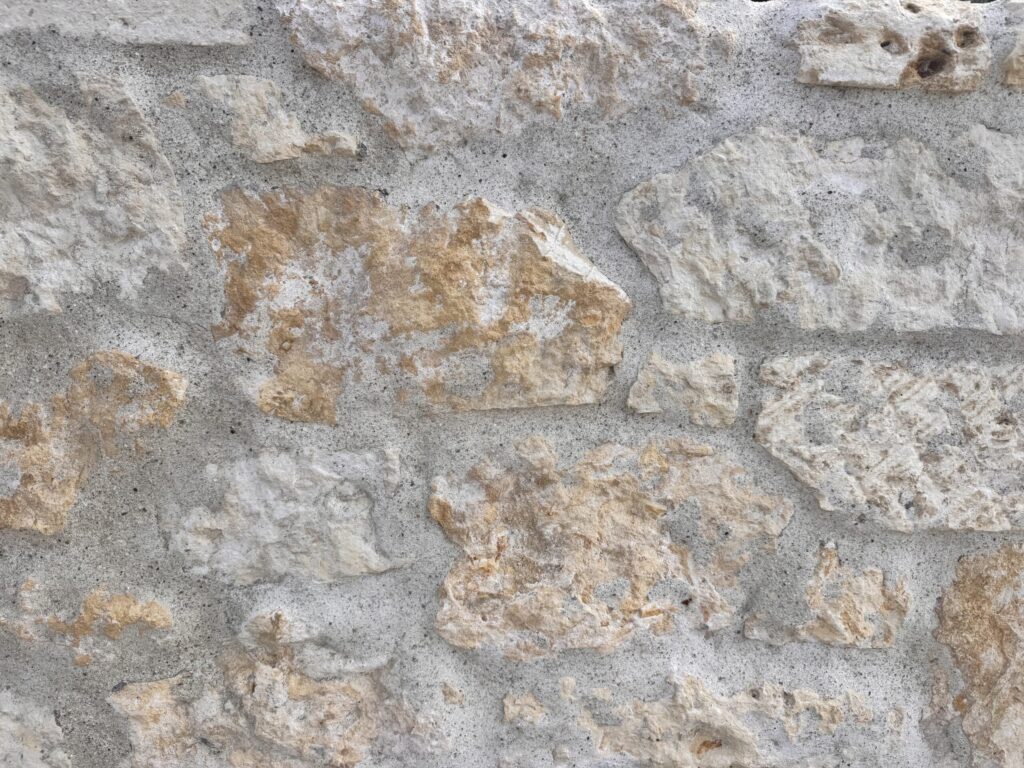
Here’s the part that gets skipped. The walls most clients actually want aren’t the architects’ work at all. While the Renaissance men measured columns, farmers in Tuscany and Umbria were building the case coloniche, the stone farmhouses the region is known for. They picked fieldstone off their own ground, split it by hand, bedded it in lime mortar, then flooded the joints and pushed mortar out over the faces of the stone until the wall was more or less sealed. Irregular rock leaves irregular gaps and gaps let water in. That was the whole reasoning.
Five hundred years of weather later, that waterproofing shortcut is the most copied masonry finish on earth. We call it overgrout and clients pay extra for it.
How it got here
Twice, by two different routes.
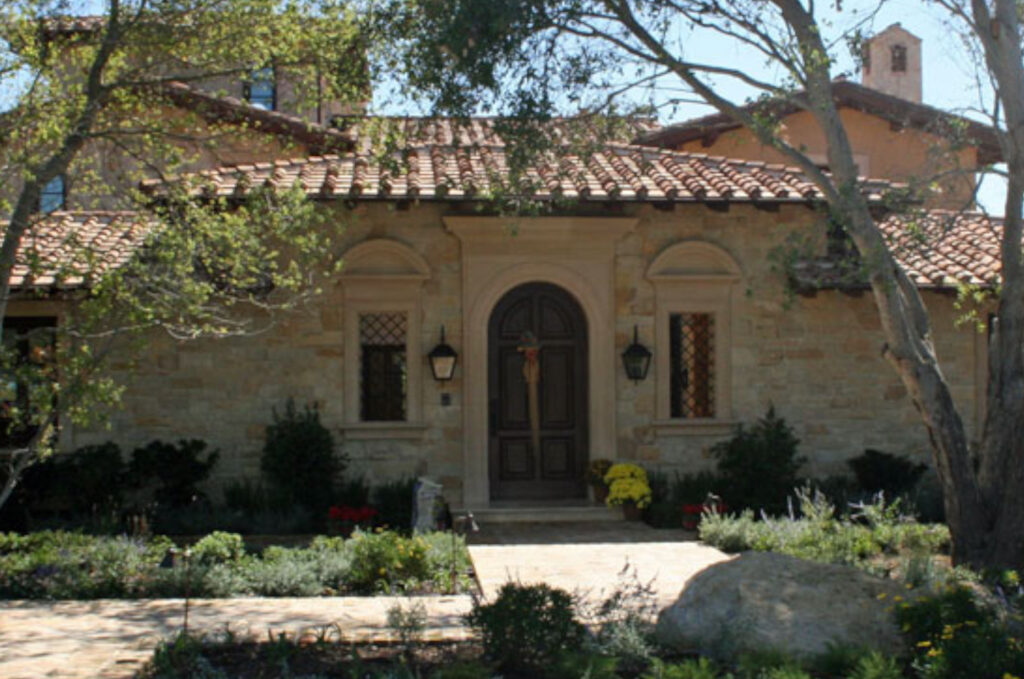
Through Spain first. The missions went up by hand out of local material, and the Santa Barbara mission’s facade is native sandstone quarried close by. California sandstone runs warm and tawny and has always sat well beside Mediterranean architecture, which is no accident, since it’s the same approach applied to a different rock. Our Beverly Blend is that stone, full-color native California sandstone, the material behind the missions and a good deal of Montecito.
Then again in the 1910s and 20s, when American architects went to Italy and Spain to sketch and measure the way Brunelleschi had, and came home building Mediterranean Revival and Spanish Colonial Revival. George Washington Smith made most of his career on it in Santa Barbara. The 1925 earthquake flattened much of the downtown and the city chose to rebuild in that idiom deliberately, which is why an Italian villa on this coast doesn’t look imported.
What we stock for it
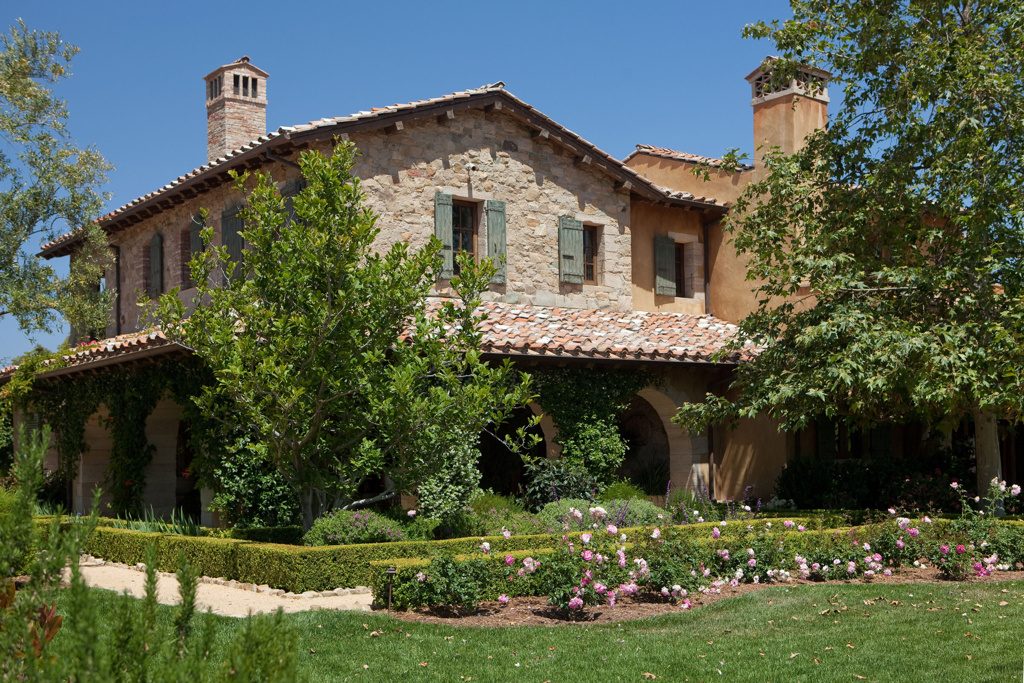
Most of our natural thin stone veneer line was put together with this architecture in mind, and it splits roughly by country. It goes on exterior facades and entries, chimneys and fireplace surrounds inside and out, wine cellars, outdoor kitchens, courtyard and garden walls, and the arches and gable ends that carry most of the European character on a house.
On the Italian side, Villa Blend is cream, buff and gold limestone squared in mixed sizes with dressed surrounds at the entries, and it’s usually where we start when somebody hands us a Mediterranean villa photo. Milan Blend is golden buff and honey in a tighter mosaic lay with the arches turned in thin brick, a little more refined, better on a house with a lot of window detail. Olive Mill Blend runs silvery gray, buff and honey gold in tight courses, patterned on an old Tuscan mill house, and it takes an overgrout as well as anything we carry.
West into France, Chateau Blend is a buff, gold and soft gray rubble in mixed sizes that sits right under a tile roof. French Reclaim Blend is an actual French reclaim cut down for thin veneer with the accent pieces fabricated out of domestic limestone, and it’s what we go to when nothing else reads old enough. Lisbon Blend is ivory and cream with pale gold, more Iberian and sun-bleached, good on garden walls and courtyard gates.
For a broader countryside look there’s Euro Blend, a coursed ledge-and-rubble mix with the arches turned in the field stone, which is what we reach for when there’s a turret or a heavy arched entry to carry. Highland Blend is white limestone with buff and nicotine tones in a chopped rubble mix. South Bay and Brentwood are white limestone under heavy overgrout, brighter, and they turn up on projects near the water. The Brentwood house ran on the cover of Architectural Digest and it’s in our project gallery with the rest.
Courtyards, loggias and garden walls need the ground to match, and our reclaimed paving and flagstone covers that side of it. The full product line is here if you’d rather browse before you call.
Ask us for samples before you decide anything. Stone photographs badly, and worse on a phone. A limestone you liked on a screen and the same limestone sitting on a table in afternoon light are frequently not the same limestone. Tell us the architecture and we’ll get three or four in your hands. Request samples here or call 805-905-5539.
What does natural stone veneer cost?
The honest answer is that it depends on the blend, the quarry, the freight and how much of the wall is corners and dressed openings, which is why nobody who tells you a single number over the phone is being straight with you. What we can do is give you a real one fast. Send elevations or a square footage and we’ll run a takeoff and come back with a budget figure you can actually build against.
A few things that move the number more than people expect. Corners cost more than field stone and most elevations need more of them than anyone estimates. Custom fabricated surrounds, sills and thresholds are cut to your specific openings and priced accordingly. Reclaimed material carries a premium because there’s a finite amount of it. And freight on stone is not trivial, so a domestic blend and an imported one that look similar can price very differently.
Manufactured stone will always be cheaper up front. Whether it’s cheaper over the life of the house is a different question, covered below.
The decisions that actually determine what you get
Mortar color. Nobody asks about this until the wall is halfway up, and on an overgrout job it matters as much as the stone. If mortar is washing across the faces it’s covering a third of the wall or more, which makes it a field decision, not a trim decision. The sand does most of the work. A standard gray mix over warm gold limestone will flatten the whole elevation, and there’s no fixing it afterward short of grinding. Get a buff or tan mix and settle it with your mason before he starts.
Build a panel first. Four by four, on the house or right next to it, using the stone you bought, the mortar you picked and the man who’s laying the rest of it. Leave it up a couple of days and look at it more than once. It costs a day and it settles arguments that otherwise happen at 2,000 square feet.
Texture, and how samples lie about it. The look depends on relief. Split faces, natural clefts, real depth. Sawn-smooth or heavily tumbled stone won’t get there. The trouble is that a single sample piece tells you almost nothing about relief, because you’re looking at it flat in your hand instead of stacked on a wall in raking light. Get several pieces and set them up vertically.
Chisel and pitch marks. When a mason squares a stone with a pitching tool, the blow fractures the face and leaves a raised rock face with a broken edge. Those marks are why the eye reads a wall as old. Same effect the Romans were after at the Porta Maggiore, and the first thing that disappears when stone gets machined for uniformity.
Irregular sizing. Squares and rectangles mixed with rubble, big pieces beside small ones, courses that break and wander. Old walls were built from whatever was in the pile. A blend that arrives in three tidy sizes will look manufactured no matter how good the stone is.
Dressed stone at the openings. This is what separates a villa from a farmhouse, and it’s the first line item people cut. Cut limestone surrounds, sills, headers, keystones, quoins, smooth against the rough field. Nearly all of it has to be custom fabricated to your actual opening dimensions, which means it can’t be ordered until the openings are dimensioned, which means somebody has to be thinking about it early. Usually nobody is.
Corners. Thin veneer is about an inch thick and will announce that at every outside corner unless you’re using proper L-shaped corner units. Same problem in reverse at door and window returns. Count corners off the elevations instead of estimating, and order them with the field stone rather than after.
Natural stone veneer vs. manufactured and faux stone
For most of this history the look required full-bed stone, three to five inches or more, with footings and a ledge sized to carry it. If the house wasn’t designed for stone up front, you weren’t getting stone.
Thin veneer is the same material sawn down to roughly an inch. Real quarried limestone or sandstone off the same block that produces full bed, cut thin. It generally runs under 15 pounds per square foot, which in most applications is what lets it go over a properly prepared wall as an adhered veneer without the structural support full-thickness masonry needs. Visually it’s the same stone. The decision comes down to what the structure was built to carry and how the corners and openings are getting detailed.
What it is not is manufactured, cultured or faux stone. Those are all the same thing: molded concrete with pigment in it, poured from a limited number of face molds, which is why a manufactured wall starts repeating itself once you know to look. The pigment is surface-deep, so chips show gray, and sun fades it. Natural stone doesn’t repeat, doesn’t fade, and the color goes all the way through because it is the color. On a house whose entire effect depends on looking two hundred years old, that isn’t a small distinction.
If you’re the architect, the designer or the builder
Bring us in earlier than you think you need to. Stone is frequently the long pole on a custom home and it’s usually the last thing anybody worries about. Quarry runs are seasonal, container freight is slow, and fabricated surrounds and sills can’t be cut until the openings are dimensioned. A blend sitting on the ground in March can be four months out by September.
Send plans and we’ll do a takeoff and get you a real budget number while there’s still room to change a blend or resize an opening. Send a photo out of a client’s folder and we’ll tell you what it is, whether it’s available and what it costs. Send a chunk of stone off an existing house and we’ll match it. That’s most of the job on our end.
Where to buy natural stone veneer in Southern California
Family business, Thousand Oaks. Forty-odd years in construction, twenty-five in stone, same family the whole time. We supply natural stone veneer, paving and boulders for custom homes and landscapes across Ventura County, Santa Barbara, Montecito, Malibu, Calabasas, Thousand Oaks, Pacific Palisades, Brentwood and Bel Air, and we’ve shipped a good deal farther than that, Lanai to Jakarta.
We don’t lay stone. We source it, and we’ll put you in touch with masons we trust who know overgrout work, which is not a finish to hand somebody who hasn’t done it before.
Call 805-905-5539, email dale@stonemangroupinc.com, or get in touch here. Send photos, send plans, or just tell us what you’re building. We answer the phone.
Questions we get
How much does natural stone veneer cost? It moves with the blend, the quarry, the freight, and how much of the job is corners and fabricated openings, so a single number quoted sight unseen is a guess. Send us elevations or a square footage and we’ll run a takeoff and give you a budget figure. Manufactured stone is cheaper up front; natural stone doesn’t fade, doesn’t repeat and doesn’t need replacing.
What’s the difference between natural stone veneer and faux or manufactured stone? Natural veneer is quarried stone sawn to about an inch thick. Manufactured, cultured and faux stone are all molded concrete with pigment, poured from a limited set of face molds, which is why those walls visibly repeat. The pigment sits on the surface, so chips show gray and sun fades the color. Natural stone is colored all the way through and weathers instead of fading.
Can you put stone veneer over stucco? In many cases yes, and in Southern California it’s one of the most common ways a plain stucco house becomes a Mediterranean or Tuscan one without touching the foundation. The wall has to be properly prepared and detailed, which is your mason’s call and your building department’s. On the material side, thin veneer’s low weight is exactly what makes it possible. Tell us what you’ve got and we’ll tell you what will work on it.
What kind of stone is used on Italian villas? Limestone, almost always. The Mediterranean sits on it. Cream, buff, gold, honey and silvery gray are the tones that read as Italian, with travertine common in and around Rome. Dressed limestone gets used for the surrounds, sills and quoins at the openings. We stock several European limestone blends cut for exactly this.
What color stone should I use for a Tuscan look? Warm and mixed rather than uniform. Buff, gold, honey, soft gray. Tuscan walls came out of local fieldstone in whatever range the ground gave up, so a blend with real color movement always looks more convincing than a flat single tone. Keep the mortar on the warm side of the blend, not gray.
What’s the best stone veneer for a fireplace? Indoors, most of these blends work, and the choice is usually about scale: a tight coursed blend like Milan or Olive Mill suits a smaller surround, while a rubble mix like Chateau or Euro carries a two-story chimney breast better. Outdoor fireplaces and chimneys want the same stone as the facade so the elevation reads as one building. Bring us the fireplace dimensions and we’ll tell you which blends sit right at that size.
What mortar color should I use with old world stone veneer? Match the warm end of the blend. Buff and tan mixes over gold and cream limestone. Standard gray portland mixes are what most crews default to and they will kill a warm wall, especially under an overgrout where mortar covers so much of the face. It’s a sand decision as much as anything. Involve your mason before the job starts, and ask us which direction a given blend wants to go.
What is overgrouting? A mortar finish where the joints are deliberately overfilled and washed out across the faces and edges of the stone instead of raked back into clean lines. It buries the outline of each stone so the wall reads as one surface, and it hides the size mismatches that make a rubble blend look chaotic. It comes straight from Tuscan farmhouse masons sealing their walls against water.
What is rustication in architecture? A Roman technique where the face of a block is left rough and textured while the margins are cut clean and square. It makes stonework read as heavy and permanent. Rome used it on gates and aqueducts, Renaissance Florence used it on the ground floors of the palazzi, and it’s the basis of the textured facades still going up today.
What’s the difference between Italian villa stone and French chateau stone? Lay and color temperature, mostly. Italian work runs to squared limestone in tighter courses with dressed surrounds, creams and golds. French chateau and country work is more rubble, more mixed sizing, cooler grays alongside the buff, often with brick or cut stone turning the arches.
Where can I buy stone veneer near me in Southern California? We’re in Thousand Oaks and supply Ventura County, Santa Barbara, Montecito, Malibu, Calabasas and the Los Angeles westside constantly, plus projects nationally and internationally. Call 805-905-5539 or send us photos of the look you’re after.